Publications

6 papers, newest first. Also on Google Scholar and ORCID.

2026

JASMS

Native, Memory-Bounded Conversion of Mass Spectrometry Imaging Data into the SpatialData Ecosystem

T. Visvikis, W.-M. Vierdag, L. Marconato, A. Birmpili, R. M. A. Heeren, E. Cuypers

Journal of the American Society for Mass Spectrometry (2026)

@article{visvikis2026native,
  title   = {Native, Memory-Bounded Conversion of Mass Spectrometry Imaging Data into the SpatialData Ecosystem},
  author  = {Visvikis, Theodoros and Vierdag, Wouter-Michiel and Marconato, Luca and Birmpili, Angeliki and Heeren, Ron M. A. and Cuypers, Eva},
  journal = {Journal of the American Society for Mass Spectrometry},
  year    = {2026},
  doi     = {10.1021/jasms.6c00169}
}
Nat Methods

Spatialproteomics: an interoperable toolbox for analyzing highly multiplexed fluorescence image data

M. Meyer-Bender, H. Vöhringer, C. Schniederjohann, …, T. Visvikis, …, W. Huber (24 authors)

Nature Methods 23(8), 1564–1573 (2026)

@article{meyerbender2026spatialproteomics,
  title   = {Spatialproteomics: an interoperable toolbox for analyzing highly multiplexed fluorescence image data},
  author  = {Meyer-Bender, Matthias and Vöhringer, Harald and Schniederjohann, Christina and Koziel, Sarah and Chung, Erin and Popova, Ekaterina and Brobeil, Alexander and Griese, Nicklas and Kolks, Nora and Held, Lisa-Maria and Munir, Aamir and {Scverse Community} and Koutrouli, Mikaela and Marconato, Luca and Vierdag, Wouter-Michiel and Diedrich, Lucas and Brennsteiner, Vincenth and Visvikis, Theodoros and Nimo, Jose and Roussos, Panos and Schoof, Erwin and Dietrich, Sascha and Bruch, Peter-Martin and Huber, Wolfgang},
  journal = {Nature Methods},
  year    = {2026},
  volume  = {23},
  number  = {8},
  pages   = {1564--1573},
  doi     = {10.1038/s41592-026-03155-1}
}

Nat Biotechnol

Unpaired data as a first-order challenge in single-cell and spatial proteomics

M. Koutrouli, F. Finotello, E. M. Schoof, P. Roussos, on behalf of the scverse Proteomics Consortium (incl. T. Visvikis)

Nature Biotechnology 44(6), 891–892 (2026)

@article{koutrouli2026unpaired,
  title   = {Unpaired data as a first-order challenge in single-cell and spatial proteomics},
  author  = {Koutrouli, Mikaela and Finotello, Francesca and Schoof, Erwin M. and Roussos, Panos and Vierdag, Wouter-Michiel and Diedrich, Lucas and Meyer-Bender, Matthias and Kuehl, Malte and Nimo, Jose and Vöhringer, Harald and Visvikis, Theodoros and Brennsteiner, Vincenth and Marconato, Luca and Aragon-Fernandez, Pedro and Petschko, Felix and Marco Salas, Sergio and Leote, Carolina and Rose, Christopher M. and FNU, Prashant and Hoffman, Gabriel E. and Heeren, Ron M. A. and Gaifas, Lorenzo and Petrosius, Valdemaras and Puelles, Victor G. and Cuypers, Eva and Mann, Matthias and Coscia, Fabian and Saka, Sinem K. and Huber, Wolfgang and Marioni, John C. and Theis, Fabian J.},
  journal = {Nature Biotechnology},
  year    = {2026},
  volume  = {44},
  number  = {6},
  pages   = {891--892},
  doi     = {10.1038/s41587-026-03074-8}
}

2025

Sci Rep

One section, two worlds: single-cell integration of MALDI-MSI and spatial transcriptomics on the same single tissue section

T. F. E. Hendriks, G. B. Eijkel, T. Visvikis, B. Balluff, R. M. A. Heeren, E. Cuypers

Scientific Reports 15(1), 42660 (2025)

@article{hendriks2025one,
  title   = {One section, two worlds: single-cell integration of MALDI-MSI and spatial transcriptomics on the same single tissue section},
  author  = {Hendriks, Tim F. E. and Eijkel, Gert B. and Visvikis, Theodoros and Balluff, Benjamin and Heeren, Ron M. A. and Cuypers, Eva},
  journal = {Scientific Reports},
  year    = {2025},
  volume  = {15},
  number  = {1},
  pages   = {42660},
  doi     = {10.1038/s41598-025-26735-1}
}

JASMS

Mass Spectrometry Imaging for Spatial Ingredient Classification in Plant-Based Food

M. Vats, B. Flinders, T. Visvikis, C. Dawid, T. F. Hofmann, E. Cuypers, R. M. A. Heeren

Journal of the American Society for Mass Spectrometry 36(1), 100–107 (2025)

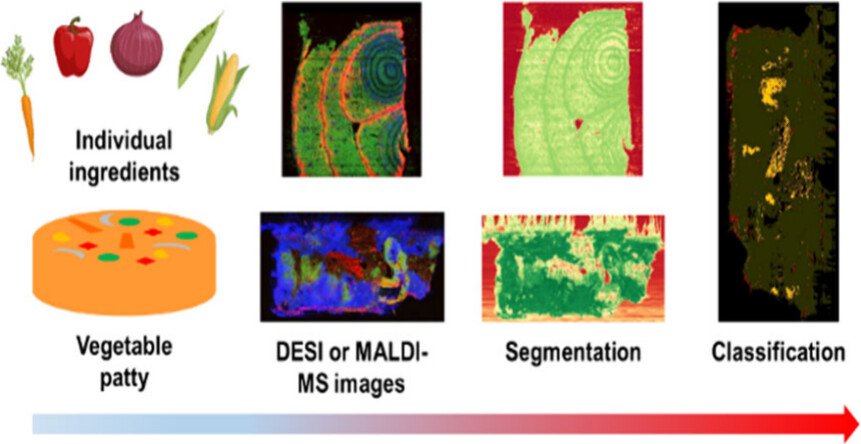
Graphical abstract of Mass Spectrometry Imaging for Spatial Ingredient Classification in Plant-Based Food

Mass spectrometry imaging (MSI) techniques enable the generation of molecular maps from complex and heterogeneous matrices. A burger patty, whether plant-based or meat-based, represents one such complex matrix where studying the spatial distribution of components can unveil crucial features relevant to the consumer experience or production process. Furthermore, the MSI data can aid in the classification of ingredients and composition. Thin sections of different burger samples and vegetable constituents (carrot, pea, pepper, onion, and corn) were prepared for matrix-assisted laser desorption/ionization (MALDI) and desorption electrospray ionization (DESI) MSI analysis. MSI measurements were performed on all samples, and the data sets were processed to build three machine learning models aimed at detecting meat adulteration in vegetable burger samples, identifying individual ingredients within the vegetable burger matrix, and discriminating between burgers from different manufacturers. Ultimately, the successful detection of adulteration and differentiation of various burger recipes and their constituent ingredients were achieved. This study demonstrates the potential of MSI coupled with building machine learning models to enable the comprehensive characterization of burgers, addressing critical concerns for both the food industry and consumers.

@article{vats2025mass,
  title   = {Mass Spectrometry Imaging for Spatial Ingredient Classification in Plant-Based Food},
  author  = {Vats, Mudita and Flinders, Bryn and Visvikis, Theodoros and Dawid, Corinna and Hofmann, Thomas F. and Cuypers, Eva and Heeren, Ron M. A.},
  journal = {Journal of the American Society for Mass Spectrometry},
  year    = {2025},
  volume  = {36},
  number  = {1},
  pages   = {100--107},
  doi     = {10.1021/jasms.4c00353}
}

2024

JASMS

The Application of a Random Forest Classifier to ToF-SIMS Imaging Data

M. A. Shamraeva, T. Visvikis, S. Zoidis, I. G. M. Anthony, S. Van Nuffel

Journal of the American Society for Mass Spectrometry 35(12), 2801–2814 (2024)

Special issue: Advanced Data Analysis in Secondary Ion Mass Spectrometry (SIMS)

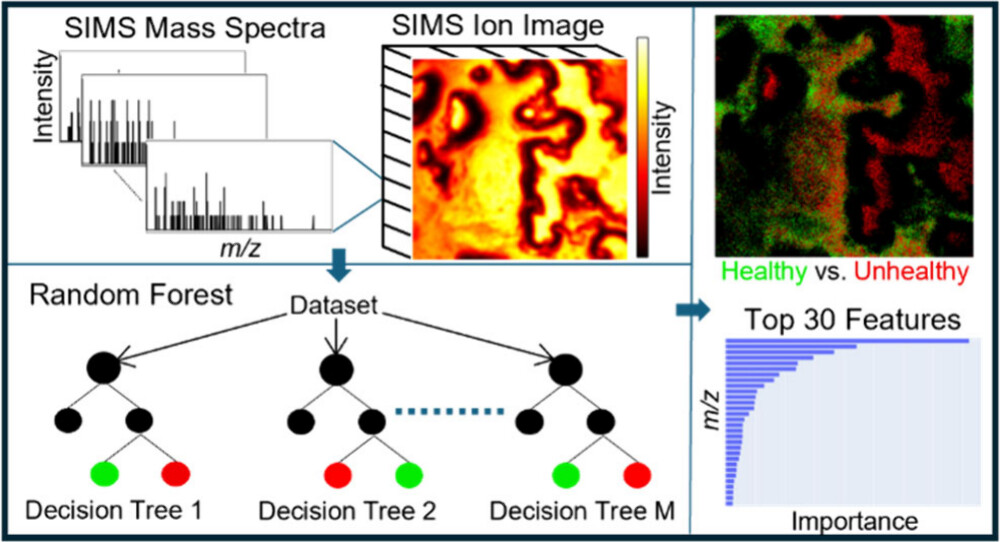
Graphical abstract of The Application of a Random Forest Classifier to ToF-SIMS Imaging Data

Time-of-flight secondary ion mass spectrometry (ToF-SIMS) imaging is a potent analytical tool that provides spatially resolved chemical information on surfaces at the microscale. However, the hyperspectral nature of ToF-SIMS datasets can be challenging to analyze and interpret. Both supervised and unsupervised machine learning (ML) approaches are increasingly useful to help analyze ToF-SIMS data. Random Forest (RF) has emerged as a robust and powerful algorithm for processing mass spectrometry data. This machine learning approach offers several advantages, including accommodating nonlinear relationships, robustness to outliers in the data, managing the high-dimensional feature space, and mitigating the risk of overfitting. The application of RF to ToF-SIMS imaging facilitates the classification of complex chemical compositions and the identification of features contributing to these classifications. This tutorial aims to assist nonexperts in either machine learning or ToF-SIMS to apply Random Forest to complex ToF-SIMS datasets.

@article{shamraeva2024application,
  title   = {The Application of a Random Forest Classifier to ToF-SIMS Imaging Data},
  author  = {Shamraeva, Mariya A. and Visvikis, Theodoros and Zoidis, Stefanos and Anthony, Ian G. M. and Van Nuffel, Sebastiaan},
  journal = {Journal of the American Society for Mass Spectrometry},
  year    = {2024},
  volume  = {35},
  number  = {12},
  pages   = {2801--2814},
  doi     = {10.1021/jasms.4c00324}
}