I am a PhD candidate at M4i, Maastricht University in Netherlands in the group of Eva Cuypers with a main focus on single-cell multi-omics data integration, analysis, and management.
I received my Bachelor's diploma in Science at the Maastricht Science Program, with a main focus on analytical chemistry, performing my bachelor's thesis under the supervision of Maarten Honing, with a main focus on the use of liquid chromatography, mass spectrometry, and ion mobility spectrometry. After graduating, I worked for a year of working under Maarten Honing, completing the results of the thesis, and working in the development of flow chemistry sensors to be used for process analytical technologies. Soon after, I started my Master's degree at Maastricht University Molecular Imaging & Engineering, graduating with a thesis under the supervision of Ron Heeren & Maarten Honing. There, I focused on the application of imaging technologies, chiefly Mass Spectrometry Imaging (MSI), and how to apply this technique in food science to investigate the spatial molecular heterogeneity of non-animal-based meat alternatives. In parallel, I got familiar with the application of machine learning approaches in the data analysis, picking an interest in the field of imaging data analysis & management.
The current focus of my PhD is single-cell multi-omics data integration, analysis, and management. I believe that MSI can greatly expand on the field of multi-omics, as it can provide a breadth of additional molecular information, however, lots of work is necessary to integrate the data into existing multi-omics frameworks and perform data analysis.
News
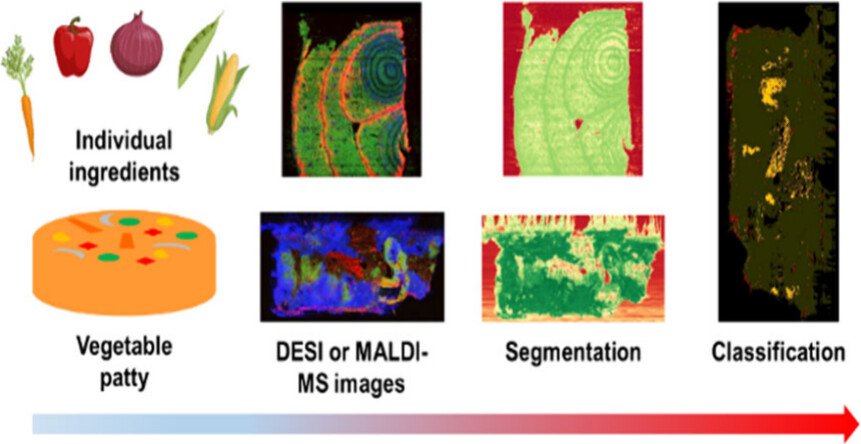
A new paper that we worked on has been published at JASMS, titled: Mass Spectrometry Imaging for Spatial Ingredient Classification in Plant-Based Food. Ever wondered how we can apply ML on MSI data for classification of constituents? In this paper we show three approaches to do this. Firstly an unsupervised approach to figure out the hetereogeneity or adulteration of your samples. Secondly a semi-supervised approach to train and identify ingredients in plant-based burger. Finally, a supervised approach to figure out important peaks that can separate between different samples or, in our cases, different burgers. Find our paper by clicking here
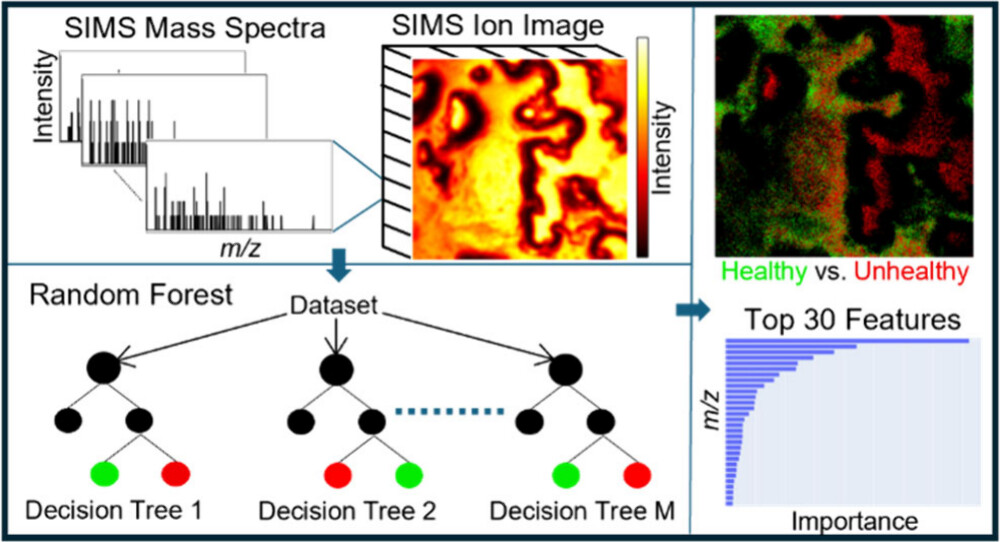
I am excited to announce to that our tutorial paper on how to apply Random Forest classifiers to ToF-SIMS imaging data has been published at JASMS and can be found here . Analysis of ToF-SIMS datasets can be quite challenging due to the lack or low intensity of molecular ions and the abundance of fragments leading to highly dimensional and highly collinear data. While Random Forest models have some robustness against these problems, we show that we can improve the performance of our classifier model by setting collinearity thresholds and removing redundant features. At the same time this leads to a cheaper & simpler model to train with less overfitting. What’s there not to like?